
19September 2026
Today’s poster
What to note today
- 01
- 02
- 03
- 04
Popular searches
Current-affairs study
Daily, weekly and monthly current affairs for UPSC, SSC, banking, railway and state PSC exams — every item dated and checked at its source, with the question it becomes and a quiz with answers.
Current affairs · 19 September 2026
Every item is dated, read on the conducting body’s or ministry’s own site, and written with the question it becomes. Read today’s items, take the quiz, or download the month as a PDF.
Today’s poster
Revision method
These guides explain how to select, organise and revise current events; verify each event at its primary source.
Browse
The same events, filtered the way you revise.
Current affairs — September 2026
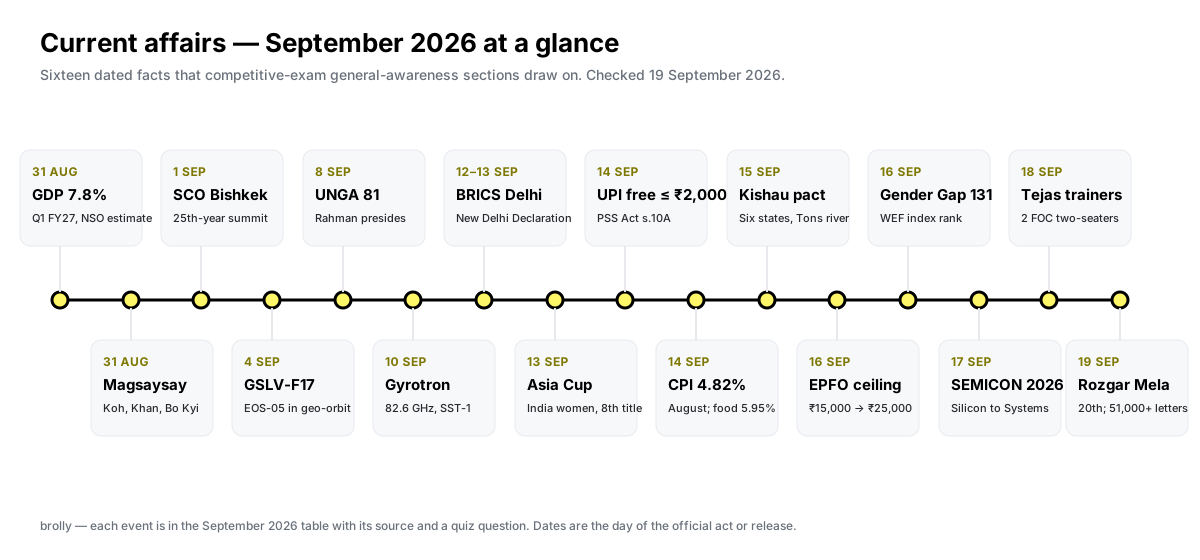
One dataset feeds every page in this section — today, this week, this month, each topic and each exam — so a fact appears wherever it belongs. The eight latest items are below; the monthly page carries all of them.
| Date | What happened | Why it is asked |
|---|---|---|
| 19 September | 20th Rozgar Mela: more than 51,000 appointment letters at 45 locations. The Prime Minister distributed more than 51,000 appointment letters to newly recruited central government employees at the 20th Rozgar Mela on 19 September 2026, by video conference to 45 locations; the recruits join the Department of Revenue, the Railways, the Home Ministry, Health and Family Welfare, Financial Services and Defence among others. With this edition about 12.75 lakh appointment letters have been handed over under the Rozgar Mela since it began in October 2022. | Edition number, the letters handed over and the cumulative figure are the recurring questions. (Prime Minister’s Office, 18 September 2026.) |
| 19–20 September | NGT hosted an international conference on environment and climate dynamics. The Prime Minister inaugurated the National Green Tribunal’s two-day International Conference on “The Future of Environment and Climate Dynamics” at Vigyan Bhawan on 19 September 2026, bringing together judges of the Supreme Court and High Courts, judicial representatives from 17 countries, state environment impact assessment and wetland authorities and legal services authorities to compare judicial approaches to environmental governance and enforcement. | The organiser (NGT, a statutory tribunal of 2010), the venue and the 17 participating countries are the examinable points. (Prime Minister’s Office, 18 September 2026.) |
| 19 September – 4 October | Asian Games 2026 open in Aichi-Nagoya with 496 Indian athletes. The 20th Asian Games run from 19 September to 4 October 2026 in Aichi-Nagoya, Japan, with the opening ceremony at the Mizuho Park athletic stadium in Nagoya. India is sending 496 athletes — 264 men and 232 women — across 36 sports, including P. V. Sindhu, Mirabai Chanu, Murali Sreeshankar and the men’s and women’s hockey, cricket and kabaddi teams. At Hangzhou 2022 India won a record 107 medals including 28 gold. | Host city and country, dates, edition, India’s contingent and the Hangzhou tally are asked before and after the Games; the medal table will be asked afterwards. (Indian Olympic Association / Aichi-Nagoya 2026 organising committee.) |
| 18 September | A 100-week Nasha Mukt Yuva Abhiyan opened with a national pledge day. The Ministry of Youth Affairs and Sports launched the 100-week “Nasha Mukt Yuva Abhiyan — drug-free youth for a Viksit Bharat” with a Rashtriya Sankalp Samaroh on 18 September 2026, organised with MY Bharat and the National Service Scheme across all 28 states and 8 Union Territories: mass pledges, signature drives and youth dialogues against substance abuse. | The ministry, the 100-week span and the implementing platforms (MY Bharat, NSS) are the details to hold. (PIB, Ministry of Youth Affairs and Sports, 18 September 2026.) |
| 18 September | HAL handed the IAF two Tejas FOC twin-seat trainers and three HTT-40s. At Bengaluru on 18 September 2026, in the presence of the Defence Minister and the Civil Aviation Minister, Hindustan Aeronautics Limited handed over to the Indian Air Force two Light Combat Aircraft Tejas twin-seat trainers in the final operational clearance standard — the last two under the FOC contract — and three HTT-40 basic trainer aircraft, and delivered four Dhruv-NG helicopters to Pawan Hans, the first civil-certified version of the indigenous helicopter. | The aircraft names, the maker, the receiving forces and the “last two under the FOC contract” are the details questions draw on. (PIB, Ministry of Defence, 18 September 2026.) |
| 18 September | Navy issued Stage II call-ups for the Agniveer 1/27 batch. The Indian Navy issued Stage II call-up letters for the Agniveer SSR, MR and Apprentice 1/27 batch — candidates who cleared the INET 2026 held from May — for download through the candidate login on joinindiannavy.gov.in, with Stage II at the naval recruitment establishments; the 2/27 batch call-ups are due in early 2027. | Recruitment-cycle fact for candidates; not a general-awareness question. (joinindiannavy.gov.in, 18 September 2026.) |
| 17–19 September | SEMICON India 2026 opened at Yashobhoomi on the theme “Silicon to Systems”. The Prime Minister inaugurated the fifth SEMICON India on 17 September 2026 at Yashobhoomi, Dwarka, New Delhi, organised by the India Semiconductor Mission, MeitY and SEMI on the theme “Silicon to Systems: Building the Ecosystem” and running to 19 September: more than 600 companies from 52 countries, six country pavilions (Japan, South Korea, Malaysia, the Netherlands, Singapore and Sweden), twelve state pavilions and a “Sand to Silicon to Systems” value-chain walk-through. Twelve projects stand approved under the Semicon India programme and three of the first-phase units have begun commercial production. | Edition, venue, theme, organisers and the six pavilion countries are asked; so is the count of approved projects. (Prime Minister’s Office note of 16 September 2026; inauguration confirmed by agreeing reports of 17 September.) |
| 17 September | World Patient Safety Day 2026: “Safe care for noncommunicable diseases”. World Patient Safety Day, observed on 17 September since its creation by the World Health Assembly in 2019, took the 2026 theme “Safe care for noncommunicable diseases” with the slogan “Safe care for life!”; the 2025 theme was safe care for every newborn and every child. | Day, theme and the founding body (World Health Assembly, 2019) are asked. (World Health Organization.) |
From the items above. Answer before revealing.
Q1The 20th Rozgar Mela of 19 September 2026 took the cumulative number of appointment letters distributed under the programme to about
C. 12.75 lakh — About 12.75 lakh, with more than 51,000 letters at this edition across 45 locations.
Q2The International Conference on “The Future of Environment and Climate Dynamics” of 19–20 September 2026 in New Delhi was organised by
B. the National Green Tribunal — The National Green Tribunal, with judges and judicial representatives from 17 countries; the Prime Minister inaugurated it at Vigyan Bhawan.
Q3The 20th Asian Games, opening on 19 September 2026, are being held in
B. Aichi-Nagoya, Japan — Aichi-Nagoya, Japan, from 19 September to 4 October 2026; India has sent 496 athletes across 36 sports. Doha hosts in 2030 and Riyadh in 2034.
Q4The Nasha Mukt Yuva Abhiyan launched on 18 September 2026 with a Rashtriya Sankalp Samaroh is a campaign of what length?
C. 100 weeks — 100 weeks, run by the Ministry of Youth Affairs and Sports with MY Bharat and the National Service Scheme.
Q5On 18 September 2026 HAL handed over to the Indian Air Force twin-seat trainer versions of which aircraft, completing the FOC contract?
B. LCA Tejas — Two LCA Tejas final-operational-clearance twin-seat trainers, with three HTT-40 basic trainers; four Dhruv-NG helicopters went to Pawan Hans.
Method
Reading the news and studying current affairs are different activities, and the gap between them is where most of this preparation quietly fails.
News is written to convey what happened. An examination asks what it means, which institution it concerns, which scheme it belongs to, and what number was attached to it. A candidate reading for the first and expecting to have prepared for the second will read diligently for six months and retain very little that is examinable.
It varies enormously and should determine how much time you give it. General awareness is the largest section in RRB NTPC and RPF and a substantial one in police recruitment; banking mains devotes a large block to banking awareness specifically; SSC general awareness is weighted more towards static knowledge than towards current affairs. Check the balance in your own exam’s past papers before deciding how much of your day this deserves.
Sources
The volume of current-affairs material published for aspirants is far larger than any examination requires, and most of the difference is noise. The categories below are the ones questions are actually built from.
| Category | What to record | Where it comes from |
|---|---|---|
| Government schemes and programmes | The objective, the ministry, the target group, and any figure attached. The single most reliably examined category. | The scheme’s own guidelines and the ministry’s announcement, rather than a summary of them. |
| Appointments and institutions | The office, the institution, its function and its parent ministry or constitutional basis — the institution is asked about more often than the person. | Official announcements, plus a standing note on each institution. |
| Reports, indices and rankings | The publishing body, what the index measures, and India’s position with the reference period. | The publishing organisation, since figures circulating second-hand are frequently out of date. |
| Policy, legislation and judgments | What changed, which article or act it concerns, and the argument on each side for descriptive papers. | The bill or judgment text where accessible, and reputable reporting otherwise. |
| Science, technology and defence | What a development does and who did it, rather than the date it was announced. | The agency’s own announcement. |
| Economy and finance | The instrument, the institution and the direction of a decision, tied back to the concept it rests on. | The central bank’s statements, the budget and the economic survey. |
| State-level developments | Schemes, appointments and policy in your own state, if you are sitting a state examination. | State department announcements and the state’s own publications. |
Daily lists of everything that happened, compiled without regard to what any examination asks; long monthly magazines that weight every item equally; and material that reports a figure without its reference period. These are not useless, but they are unrevisable, and unrevisable notes are the commonest failure in current-affairs preparation. If a page cannot be revised in the final fortnight, it was not worth making.
Scope
Read a verified source, record only exam-relevant facts, and revisit them through retrieval practice.
Already practising? Create Free Account to track your preparation.