
19September 2026
Today’s poster
What to note today
- 01
- 02
- 03
- 04
Popular searches
Current Affairs
Economic and banking current affairs is the section where following the news and understanding the subject diverge most sharply. A rate decision reported in a headline is a fact; the same decision understood as an instrument of monetary policy responding to an inflation reading is a piece of economics, and only the second survives a question that asks why.
That distinction matters more for some examinations than others. Banking mains papers and RBI Grade B need the understanding; a general awareness section in a police recruitment usually needs only the fact.
Current affairs · 19 September 2026
Every item is dated, read on the conducting body’s or ministry’s own site, and written with the question it becomes. Read today’s items, take the quiz, or download the month as a PDF.
Today’s poster
Economy and banking — September 2026
Three numbers anchor the month — 7.8 per cent growth, a 5.25 per cent repo rate and a ₹25,000 EPFO ceiling — and each comes with the institution, the date and the projection a question will pair it with.
| Date | What happened | Why it is asked |
|---|---|---|
| 19 September | 20th Rozgar Mela: more than 51,000 appointment letters at 45 locations. The Prime Minister distributed more than 51,000 appointment letters to newly recruited central government employees at the 20th Rozgar Mela on 19 September 2026, by video conference to 45 locations; the recruits join the Department of Revenue, the Railways, the Home Ministry, Health and Family Welfare, Financial Services and Defence among others. With this edition about 12.75 lakh appointment letters have been handed over under the Rozgar Mela since it began in October 2022. | Edition number, the letters handed over and the cumulative figure are the recurring questions. (Prime Minister’s Office, 18 September 2026.) |
| 18 September | A 100-week Nasha Mukt Yuva Abhiyan opened with a national pledge day. The Ministry of Youth Affairs and Sports launched the 100-week “Nasha Mukt Yuva Abhiyan — drug-free youth for a Viksit Bharat” with a Rashtriya Sankalp Samaroh on 18 September 2026, organised with MY Bharat and the National Service Scheme across all 28 states and 8 Union Territories: mass pledges, signature drives and youth dialogues against substance abuse. | The ministry, the 100-week span and the implementing platforms (MY Bharat, NSS) are the details to hold. (PIB, Ministry of Youth Affairs and Sports, 18 September 2026.) |
| 16 September | Cabinet raised the EPFO wage ceiling from ₹15,000 to ₹25,000. The Union Cabinet approved raising the wage ceiling for mandatory coverage under the Employees’ Provident Fund Organisation from ₹15,000 to ₹25,000 a month with effect from 17 September 2026 (Vishwakarma Jayanti), the first revision since September 2014. It brings more than 51 lakh additional employees under EPF, EPS and EDLI, with a five-year central outlay of ₹56,696 crore. | The new ceiling, the effective date, the 51 lakh figure and the three schemes (EPF, EPS, EDLI) are the examinable parts. (PIB / pmindia.gov.in, 16 September 2026.) |
| 14 September | No charges on UPI payments up to ₹2,000 and on RuPay debit cards, by notification. The Department of Financial Services notified on 14 September 2026, under section 10A of the Payment and Settlement Systems Act, 2007 as amended by Parliament in August, that RuPay debit card transactions and UPI transactions up to ₹2,000 are prescribed electronic modes on which no bank or system provider may impose any charge, directly or indirectly, on the payer or the payee. The notification settles the question of a merchant discount rate on small digital payments: person-to-person transfers of any value and merchant payments up to ₹2,000 stay free, while charges become possible above that line. | The threshold (₹2,000), the statute and section (PSS Act s.10A), the two modes named and the date are the examinable details; the RuPay exemption carries no upper limit. (Ministry of Finance notification of 14 September 2026, as reported by SCC Online and agreeing reports (the e-Gazette copy was not retrieved).) |
| 14 September | Retail inflation rose to 4.82 per cent in August 2026. MoSPI’s provisional Consumer Price Index for August 2026, on the 2024=100 base, put year-on-year retail inflation at 4.82 per cent, up from 4.45 per cent in July, with food inflation (CFPI) at 5.95 per cent against 5.52 per cent; rural inflation was 5.23 per cent and urban 4.31 per cent. The rate stays inside the RBI’s 2–6 per cent band but above the 4 per cent target the Monetary Policy Committee held the repo rate at 5.25 per cent to guard. | Headline rate, food rate, the direction of change, the new base year and the release body are asked. (MoSPI CPI press release of 14 September 2026, as reported by two agreeing sources (the MoSPI site is script-rendered).) |
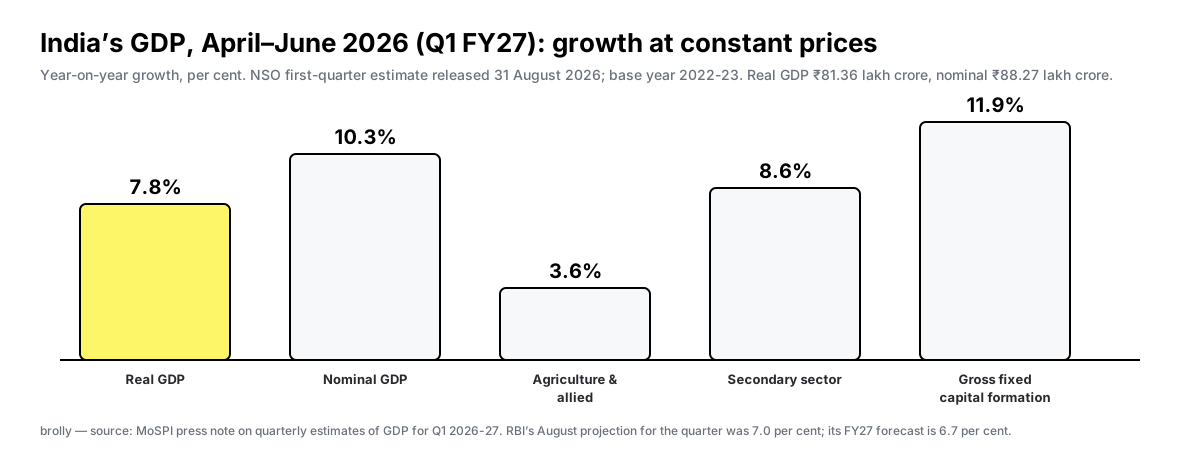
| 31 August | India’s GDP grew 7.8 per cent in Q1 FY27. The National Statistics Office’s first-quarter estimate for April–June 2026 put real GDP growth at 7.8 per cent, ahead of the RBI’s 7 per cent projection, with real GDP at ₹81.36 lakh crore and nominal GDP up 10.3 per cent to ₹88.27 lakh crore. Agriculture and allied grew 3.6 per cent, the secondary sector 8.6 per cent and gross fixed capital formation 11.9 per cent against 5.8 per cent a year earlier. | The headline growth rate, the base year (2022-23), the release body (NSO under MoSPI) and the GFCF figure are the four things asked. (MoSPI press note, 31 August 2026.) |
| 5 August | RBI kept the repo rate at 5.25 per cent for a fourth policy. The Monetary Policy Committee’s 62nd meeting (3–5 August 2026) left the policy repo rate unchanged at 5.25 per cent with a neutral stance, by a unanimous vote, and raised the FY27 growth projection to 6.7 per cent with inflation projected at 5 per cent. The next meeting is on 5–7 October 2026. | Repo rate, stance, vote and the projections are standard banking-awareness questions; note the Governor, Sanjay Malhotra. (RBI monetary policy statement, 5 August 2026.) |
Q1The 20th Rozgar Mela of 19 September 2026 took the cumulative number of appointment letters distributed under the programme to about
C. 12.75 lakh — About 12.75 lakh, with more than 51,000 letters at this edition across 45 locations.
Q2The Nasha Mukt Yuva Abhiyan launched on 18 September 2026 with a Rashtriya Sankalp Samaroh is a campaign of what length?
C. 100 weeks — 100 weeks, run by the Ministry of Youth Affairs and Sports with MY Bharat and the National Service Scheme.
Q3The Union Cabinet on 16 September 2026 raised the wage ceiling for mandatory EPFO coverage to what amount per month?
C. ₹25,000 — ₹25,000, up from the ₹15,000 fixed in September 2014, effective 17 September 2026 and covering more than 51 lakh additional employees.
Q4Under the Finance Ministry notification of 14 September 2026, UPI transactions up to what value may carry no charge from any bank or system provider?
B. ₹2,000 — ₹2,000, under section 10A of the Payment and Settlement Systems Act, 2007; RuPay debit card payments are charge-free without a limit.
Q5India’s CPI-based retail inflation for August 2026, released by MoSPI in September, was
B. 4.82 per cent — 4.82 per cent, up from 4.45 per cent in July; 5.95 per cent was food inflation and 5.25 per cent is the repo rate.
Q6What was India’s real GDP growth in the first quarter of 2026-27 (April–June 2026), as estimated by the NSO on 31 August 2026?
C. 7.8 per cent — 7.8 per cent, ahead of the RBI’s 7 per cent projection; 6.7 per cent is the RBI’s full-year FY27 forecast and 8.6 per cent the secondary sector’s growth in the quarter.
Q7At its August 2026 meeting the RBI’s Monetary Policy Committee kept the repo rate at what level?
B. 5.25 per cent — 5.25 per cent, unchanged for the fourth consecutive policy, with a neutral stance; the next MPC meeting is on 5–7 October 2026.
What gets asked
How deep to go
Also in this group
Explore
Questions
It depends on the examination. A general awareness section usually asks for facts — the policy rate, a budget figure, the name of a scheme — which a business newspaper read for headlines will supply. Banking mains papers ask about purpose and mechanism, which requires understanding why an instrument was used and what it affects. RBI Grade B and regulatory examinations ask you to analyse policy questions in writing, which requires having formed a view you can defend.
Monetary policy decisions with the rate, stance and accompanying projections; budget allocations, tax changes and the deficit target; economic indicators together with the bodies that publish them; and banking sector regulatory changes. Alongside those, institutional questions — the central bank’s functions and instruments, the roles of the various regulators, and the international financial institutions — which recur more reliably than any individual event.
For banking, insurance, regulatory and management examinations, yes — it serves the awareness sections, the reading comprehension sections and the interview stage simultaneously, which makes it among the most efficient single habits available. For examinations where economic awareness is a smaller component, a general newspaper read with attention to the economic pages is usually sufficient.
Choose your exam, learn smarter, practice consistently and track your preparation with Brolly Exam Prep.
Already practising? Create Free Account to track your preparation.