
19September 2026
Today’s poster
What to note today
- 01
- 02
- 03
- 04
Popular searches
Current Affairs
International current affairs is examined more narrowly than its scope suggests. Competitive exams are not testing general knowledge of world events; they are testing a fairly specific set of things — international institutions and their functions, summits and groupings India belongs to, bilateral developments involving India, and global reports and indices.
Knowing that narrowing is what makes the subject manageable. A candidate reading world news generally will absorb a great deal that is never asked, while missing the institutional detail that is.
Current affairs · 19 September 2026
Every item is dated, read on the conducting body’s or ministry’s own site, and written with the question it becomes. Read today’s items, take the quiz, or download the month as a PDF.
Today’s poster
International current affairs — September 2026
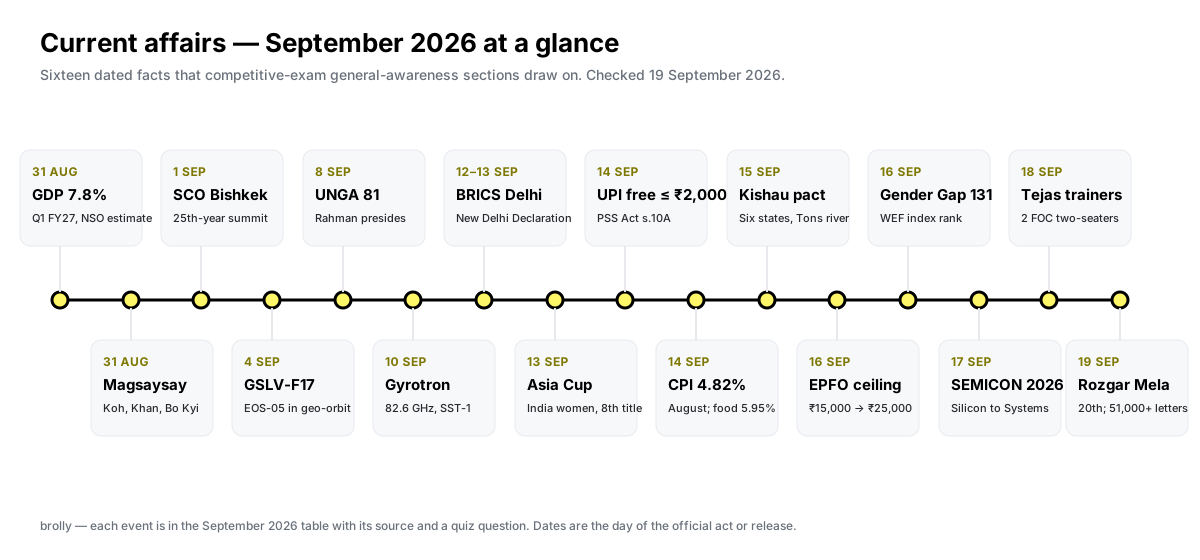
The multilateral calendar dominated the month — BRICS in New Delhi, the SCO in Bishkek, the opening of the 81st General Assembly — alongside the WEF’s gender index and Asia’s premier award.
| Date | What happened | Why it is asked |
|---|---|---|
| 16 September | India stayed 131st in the Global Gender Gap Index 2026. The World Economic Forum’s 20th Global Gender Gap Report, released on 16 September 2026, ranked India 131st of 145 countries with 64.5 per cent of its gender gap closed, unchanged in rank from 2025; Iceland led for the 17th year, followed by Finland and Norway. Globally 69.2 per cent of the gap is closed. | Rank, publisher, number of countries and the top three are what objective papers ask; UPSC may ask about the four sub-indices. (WEF Global Gender Gap Report 2026.) |
| 12–13 September | India hosted the 18th BRICS Summit in New Delhi. Under India’s 2026 chairship the 18th BRICS Summit met at Bharat Mandapam on 12–13 September 2026 under the theme “Building for Resilience, Innovation, Cooperation and Sustainability”. The New Delhi Declaration, adopted on 12 September, called for UN reform, urged restraint in West Asia, condemned unilateral tariffs and sanctions and endorsed a BRICS incubator network and start-up innovation fund. China hosts the 19th summit in 2027. | Venue, theme, name of the declaration and the next host are the four facts; note that BRICS now has eleven members. (MEA / summit documents, 12–13 September 2026.) |
| 8 September | The 81st UN General Assembly opened under a Bangladeshi president. The 81st session of the UN General Assembly opened on 8 September 2026 with Khalilur Rahman of Bangladesh as President, elected on 2 June 2026, under the theme “Restoring trust, managing transformation: a United Nations that delivers for all”. The high-level general debate follows in the week of 22 September. | Session number, the President and his country, and the theme are asked every year. (United Nations, un.org/en/ga/81.) |
| 31 August – 1 September | SCO heads of state met in Bishkek for the 25th anniversary summit. The 26th meeting of the SCO Council of Heads of State was held in Bishkek, Kyrgyzstan, on 31 August – 1 September 2026, closing Kyrgyzstan’s 2025–26 chairmanship and marking twenty-five years of the organisation founded in Shanghai in 2001. | Host city and country, the anniversary and the outgoing chair; the 2025 summit was in Tianjin. (SCO Secretariat.) |
| 31 August | Ramon Magsaysay Awards 2026 went to Tommy Koh, Runa Khan and Bo Kyi. The Ramon Magsaysay Award Foundation named three laureates for the 68th awards on 31 August 2026, the birth anniversary of the former Philippine President: Singapore’s diplomat Tommy Koh, who chaired the negotiations that produced the UN Convention on the Law of the Sea; Bangladesh’s Runa Khan, for humanitarian work among river and climate-vulnerable communities; and Myanmar’s Bo Kyi, for human-rights work. The ceremony is on 15 November 2026 in Manila. | Often called Asia’s Nobel; names, countries and fields are asked, as is the absence of an Indian laureate this year. (Ramon Magsaysay Award Foundation, 31 August 2026.) |
Q1In the World Economic Forum’s Global Gender Gap Index 2026, India was ranked
C. 131st — 131st of 145 countries, the same rank as in 2025, with 64.5 per cent of the gap closed; Iceland was first.
Q2The 18th BRICS Summit of 12–13 September 2026 was held in
C. New Delhi — New Delhi, at Bharat Mandapam, under India’s 2026 chairship; it adopted the New Delhi Declaration, and China hosts the 19th summit in 2027.
Q3Who is the President of the 81st session of the UN General Assembly, which opened on 8 September 2026?
B. Khalilur Rahman (Bangladesh) — Khalilur Rahman of Bangladesh, elected on 2 June 2026; Baerbock presided over the 80th session and Yang over the 79th.
Q4The 2026 summit of the Shanghai Cooperation Organisation’s Council of Heads of State was held in
C. Bishkek — Bishkek, Kyrgyzstan, on 31 August – 1 September 2026, the organisation’s 25th-anniversary summit; Tianjin hosted in 2025 and Astana in 2024.
Q5Which of these was a 2026 Ramon Magsaysay Award laureate?
A. Tommy Koh of Singapore — Tommy Koh, the Singaporean diplomat who chaired the UNCLOS negotiations, with Runa Khan (Bangladesh) and Bo Kyi (Myanmar); there was no Indian laureate in 2026.
India International Economy and banking Government schemes Science and technology Environment Defence Awards Sports
What gets asked
Method
Also in this group
Explore
Questions
Less than the scope suggests, and more narrowly. Exams are not testing general awareness of world events; they concentrate on international institutions and their functions, groupings and summits India participates in, bilateral developments involving India, and global reports and indices with India’s position. A candidate reading world news generally will absorb a great deal that is never asked while missing the institutional detail that is.
Build an institutional reference page and keep adding to it — every international organisation you encounter, with its headquarters, membership, leadership and function. That single page answers more examination questions than any amount of event-by-event reading, because questions about institutions recur far more reliably than questions about the events involving them.
Generally not in detail. Where conflicts are examined, the questions are usually about geography — which country, which region, which neighbours — the parties involved, and the relevant international body, rather than about the sequence of events. Connecting a country in the news to its location and neighbours on a map is therefore more useful preparation than following the developments closely.
Choose your exam, learn smarter, practice consistently and track your preparation with Brolly Exam Prep.
Already practising? Create Free Account to track your preparation.