
19September 2026
Today’s poster
What to note today
- 01
- 02
- 03
- 04
Popular searches
Current Affairs
Government schemes are the single most reliably examined category of current affairs across almost every competitive examination in India. They appear in SSC general awareness, in banking mains, in railway papers, in state examinations and in UPSC prelims, and the questions asked about them are remarkably consistent.
That consistency is what makes them worth studying systematically rather than absorbing incidentally. A scheme has a small number of examinable attributes, and recording those attributes deliberately for each scheme you encounter builds a revision resource that pays across every exam you sit.
Current affairs · 19 September 2026
Every item is dated, read on the conducting body’s or ministry’s own site, and written with the question it becomes. Read today’s items, take the quiz, or download the month as a PDF.
Today’s poster
Government schemes — September 2026
Scheme questions ask the ministry, the launch year, the beneficiary and the number attached to the latest decision. The month’s scheme items are below, then the list of schemes that recur in every general-awareness paper.
| Date | What happened | Why it is asked |
|---|---|---|
| 19 September | 20th Rozgar Mela: more than 51,000 appointment letters at 45 locations. The Prime Minister distributed more than 51,000 appointment letters to newly recruited central government employees at the 20th Rozgar Mela on 19 September 2026, by video conference to 45 locations; the recruits join the Department of Revenue, the Railways, the Home Ministry, Health and Family Welfare, Financial Services and Defence among others. With this edition about 12.75 lakh appointment letters have been handed over under the Rozgar Mela since it began in October 2022. | Edition number, the letters handed over and the cumulative figure are the recurring questions. (Prime Minister’s Office, 18 September 2026.) |
| 18 September | A 100-week Nasha Mukt Yuva Abhiyan opened with a national pledge day. The Ministry of Youth Affairs and Sports launched the 100-week “Nasha Mukt Yuva Abhiyan — drug-free youth for a Viksit Bharat” with a Rashtriya Sankalp Samaroh on 18 September 2026, organised with MY Bharat and the National Service Scheme across all 28 states and 8 Union Territories: mass pledges, signature drives and youth dialogues against substance abuse. | The ministry, the 100-week span and the implementing platforms (MY Bharat, NSS) are the details to hold. (PIB, Ministry of Youth Affairs and Sports, 18 September 2026.) |
| 17 September | World Patient Safety Day 2026: “Safe care for noncommunicable diseases”. World Patient Safety Day, observed on 17 September since its creation by the World Health Assembly in 2019, took the 2026 theme “Safe care for noncommunicable diseases” with the slogan “Safe care for life!”; the 2025 theme was safe care for every newborn and every child. | Day, theme and the founding body (World Health Assembly, 2019) are asked. (World Health Organization.) |
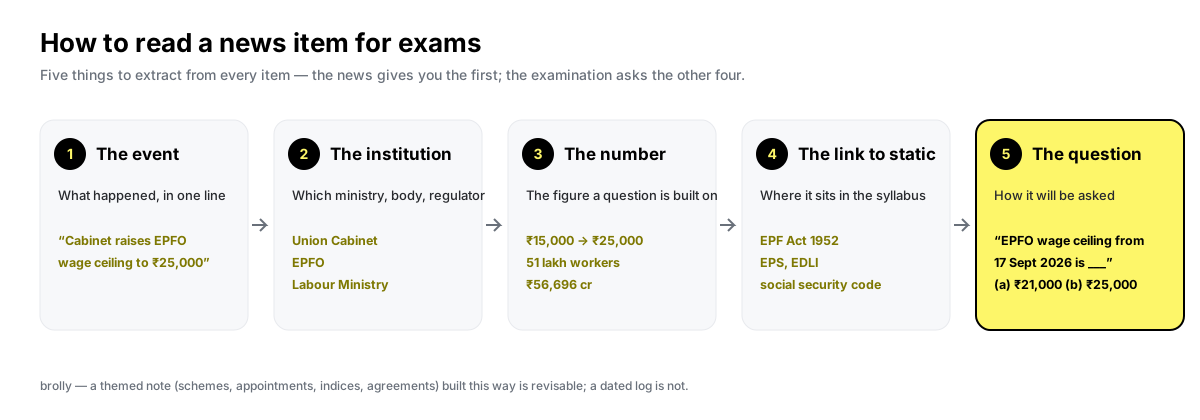
| 16 September | Cabinet raised the EPFO wage ceiling from ₹15,000 to ₹25,000. The Union Cabinet approved raising the wage ceiling for mandatory coverage under the Employees’ Provident Fund Organisation from ₹15,000 to ₹25,000 a month with effect from 17 September 2026 (Vishwakarma Jayanti), the first revision since September 2014. It brings more than 51 lakh additional employees under EPF, EPS and EDLI, with a five-year central outlay of ₹56,696 crore. | The new ceiling, the effective date, the 51 lakh figure and the three schemes (EPF, EPS, EDLI) are the examinable parts. (PIB / pmindia.gov.in, 16 September 2026.) |
| 16 September | World Ozone Day 2026 marked ten years of the Kigali Amendment. The International Day for the Preservation of the Ozone Layer on 16 September 2026 carried the theme “Global action for a cooler planet — celebrating 10 years of sustainable cooling under the Kigali Amendment to the Montreal Protocol”. The Kigali Amendment of 2016 phases down hydrofluorocarbons; the Montreal Protocol itself was signed on 16 September 1987. | Theme, the Kigali Amendment’s year and purpose, and the Montreal Protocol date are the recurring questions. (UNEP OzonAction.) |
| 14–17 September | Hindi Diwas, Engineers’ Day, International Day of Democracy and Vishwakarma Jayanti. Hindi Diwas on 14 September marks the Constituent Assembly’s adoption of Hindi as the official language in 1949; Engineers’ Day on 15 September is the birth anniversary of M. Visvesvaraya and coincides with the International Day of Democracy; 17 September, Vishwakarma Jayanti, is also observed as Sewa Divas and was the third anniversary of the PM Vishwakarma scheme launched in 2023. | Dates and their reasons — the 1949 decision, Visvesvaraya, the PM Vishwakarma launch year — are static-plus-current questions. (Government of India observances.) |
Q1The 20th Rozgar Mela of 19 September 2026 took the cumulative number of appointment letters distributed under the programme to about
C. 12.75 lakh — About 12.75 lakh, with more than 51,000 letters at this edition across 45 locations.
Q2The Nasha Mukt Yuva Abhiyan launched on 18 September 2026 with a Rashtriya Sankalp Samaroh is a campaign of what length?
C. 100 weeks — 100 weeks, run by the Ministry of Youth Affairs and Sports with MY Bharat and the National Service Scheme.
Q3The Union Cabinet on 16 September 2026 raised the wage ceiling for mandatory EPFO coverage to what amount per month?
C. ₹25,000 — ₹25,000, up from the ₹15,000 fixed in September 2014, effective 17 September 2026 and covering more than 51 lakh additional employees.
Q4The theme of World Ozone Day 2026 marked ten years of which agreement?
B. The Kigali Amendment to the Montreal Protocol — The Kigali Amendment, adopted in 2016, which phases down hydrofluorocarbons used in cooling; the Montreal Protocol itself dates from 16 September 1987.
The recurring list
| Scheme | Launched | Ministry | What is asked |
|---|---|---|---|
| PM Vishwakarma | 17 September 2023 | Micro, Small and Medium Enterprises | Eighteen traditional trades; toolkit incentive, collateral-free credit; third anniversary on 17 September 2026 |
| PM Surya Ghar Muft Bijli Yojana | February 2024 | New and Renewable Energy | Rooftop solar for one crore households; up to 300 units free a month |
| PM Awas Yojana – Urban 2.0 | August 2024 | Housing and Urban Affairs | One crore urban houses; central assistance about ₹2.30 lakh crore |
| PM-KISAN | February 2019 | Agriculture and Farmers’ Welfare | ₹6,000 a year in three instalments to landholding farmer families |
| Ayushman Bharat PM-JAY | September 2018 | Health and Family Welfare | ₹5 lakh health cover per family a year; extended to all citizens aged 70 and above in 2024 |
| PM SVANidhi | June 2020 | Housing and Urban Affairs | Collateral-free working-capital loans to street vendors, in rising tranches |
| Lakhpati Didi | Announced August 2023 | Rural Development | Self-help-group women earning ₹1 lakh or more a year; target of three crore |
| PM Gati Shakti | October 2021 | Commerce and Industry (DPIIT) | National master plan for multimodal infrastructure connectivity |
| Employees’ Provident Fund (EPF, EPS, EDLI) | EPF Act 1952 | Labour and Employment | Wage ceiling for mandatory cover raised to ₹25,000 from 17 September 2026 |
India International Economy and banking Government schemes Science and technology Environment Defence Awards Sports
What to record
Organising
Also in this group
Explore
Questions
Because they are unambiguous, verifiable and current — which makes them ideal material for an objective question. A scheme has a defined ministry, objective, target group and often a numerical target, all of which produce clean questions with a single correct answer. That is why they appear across SSC, banking, railway, state and UPSC examinations alike, and why studying them systematically pays across every exam you sit rather than just one.
Six things, briefly: the ministry or department running it, which is the most commonly asked attribute and the one most often confused; the objective in a phrase; the target group and eligibility; any numerical target or allocation; the launch year and any scheme it replaced; and whether it is a central sector, centrally sponsored or state scheme. One line per scheme is the right length — a reference page you will not re-read is useless.
By sector rather than chronologically — agriculture, health, education, housing, financial inclusion, employment, women and child development, energy. Sector grouping makes the page revisable in a few minutes and mirrors how questions cluster. It is also worth noting explicitly which schemes get confused with each other, since schemes with similar names or overlapping objectives are precisely what distractor options in objective questions are built from.
Choose your exam, learn smarter, practice consistently and track your preparation with Brolly Exam Prep.
Already practising? Create Free Account to track your preparation.