
19September 2026
Today’s poster
What to note today
- 01
- 02
- 03
- 04
Popular searches
Current Affairs
Reading the news and studying current affairs are different activities. News is written to convey what happened; an examination asks what it means, who is involved, which institution it concerns, and how it connects to a scheme, an index or a constitutional provision. Reading for the first and expecting to have prepared for the second is the commonest reason candidates find current affairs unrewarding.
The practical difference is what you record. A daily habit that produces a themed, revisable set of notes converts into marks; one that produces a feeling of being informed does not.
Current affairs · 19 September 2026
Every item is dated, read on the conducting body’s or ministry’s own site, and written with the question it becomes. Read today’s items, take the quiz, or download the month as a PDF.
Today’s poster
Today’s current affairs — 19 September 2026
The items of the last three days, each checked at the source named in the row, with the exam angle written out. Read the third column before the second: it is the form the question will take.
| Date | What happened | Why it is asked |
|---|---|---|
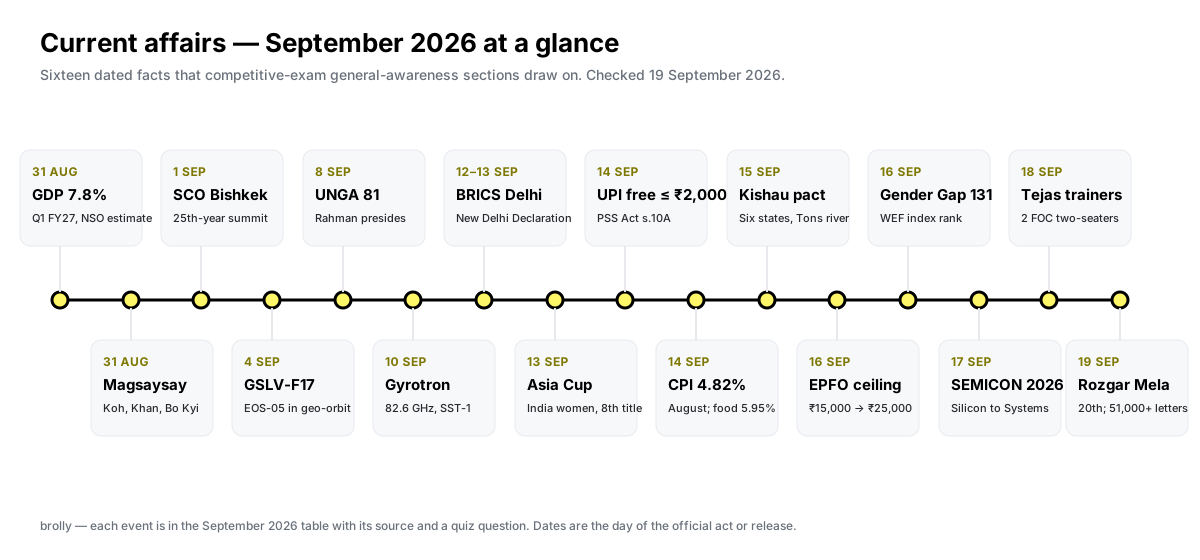
| 18 September | A 100-week Nasha Mukt Yuva Abhiyan opened with a national pledge day. The Ministry of Youth Affairs and Sports launched the 100-week “Nasha Mukt Yuva Abhiyan — drug-free youth for a Viksit Bharat” with a Rashtriya Sankalp Samaroh on 18 September 2026, organised with MY Bharat and the National Service Scheme across all 28 states and 8 Union Territories: mass pledges, signature drives and youth dialogues against substance abuse. | The ministry, the 100-week span and the implementing platforms (MY Bharat, NSS) are the details to hold. (PIB, Ministry of Youth Affairs and Sports, 18 September 2026.) |
| 18 September | HAL handed the IAF two Tejas FOC twin-seat trainers and three HTT-40s. At Bengaluru on 18 September 2026, in the presence of the Defence Minister and the Civil Aviation Minister, Hindustan Aeronautics Limited handed over to the Indian Air Force two Light Combat Aircraft Tejas twin-seat trainers in the final operational clearance standard — the last two under the FOC contract — and three HTT-40 basic trainer aircraft, and delivered four Dhruv-NG helicopters to Pawan Hans, the first civil-certified version of the indigenous helicopter. | The aircraft names, the maker, the receiving forces and the “last two under the FOC contract” are the details questions draw on. (PIB, Ministry of Defence, 18 September 2026.) |
| 18 September | Navy issued Stage II call-ups for the Agniveer 1/27 batch. The Indian Navy issued Stage II call-up letters for the Agniveer SSR, MR and Apprentice 1/27 batch — candidates who cleared the INET 2026 held from May — for download through the candidate login on joinindiannavy.gov.in, with Stage II at the naval recruitment establishments; the 2/27 batch call-ups are due in early 2027. | Recruitment-cycle fact for candidates; not a general-awareness question. (joinindiannavy.gov.in, 18 September 2026.) |
| 17–19 September | SEMICON India 2026 opened at Yashobhoomi on the theme “Silicon to Systems”. The Prime Minister inaugurated the fifth SEMICON India on 17 September 2026 at Yashobhoomi, Dwarka, New Delhi, organised by the India Semiconductor Mission, MeitY and SEMI on the theme “Silicon to Systems: Building the Ecosystem” and running to 19 September: more than 600 companies from 52 countries, six country pavilions (Japan, South Korea, Malaysia, the Netherlands, Singapore and Sweden), twelve state pavilions and a “Sand to Silicon to Systems” value-chain walk-through. Twelve projects stand approved under the Semicon India programme and three of the first-phase units have begun commercial production. | Edition, venue, theme, organisers and the six pavilion countries are asked; so is the count of approved projects. (Prime Minister’s Office note of 16 September 2026; inauguration confirmed by agreeing reports of 17 September.) |
| 17 September | World Patient Safety Day 2026: “Safe care for noncommunicable diseases”. World Patient Safety Day, observed on 17 September since its creation by the World Health Assembly in 2019, took the 2026 theme “Safe care for noncommunicable diseases” with the slogan “Safe care for life!”; the 2025 theme was safe care for every newborn and every child. | Day, theme and the founding body (World Health Assembly, 2019) are asked. (World Health Organization.) |
| 16 September | Cabinet raised the EPFO wage ceiling from ₹15,000 to ₹25,000. The Union Cabinet approved raising the wage ceiling for mandatory coverage under the Employees’ Provident Fund Organisation from ₹15,000 to ₹25,000 a month with effect from 17 September 2026 (Vishwakarma Jayanti), the first revision since September 2014. It brings more than 51 lakh additional employees under EPF, EPS and EDLI, with a five-year central outlay of ₹56,696 crore. | The new ceiling, the effective date, the 51 lakh figure and the three schemes (EPF, EPS, EDLI) are the examinable parts. (PIB / pmindia.gov.in, 16 September 2026.) |
| 16 September | India stayed 131st in the Global Gender Gap Index 2026. The World Economic Forum’s 20th Global Gender Gap Report, released on 16 September 2026, ranked India 131st of 145 countries with 64.5 per cent of its gender gap closed, unchanged in rank from 2025; Iceland led for the 17th year, followed by Finland and Norway. Globally 69.2 per cent of the gap is closed. | Rank, publisher, number of countries and the top three are what objective papers ask; UPSC may ask about the four sub-indices. (WEF Global Gender Gap Report 2026.) |
| 16 September | World Ozone Day 2026 marked ten years of the Kigali Amendment. The International Day for the Preservation of the Ozone Layer on 16 September 2026 carried the theme “Global action for a cooler planet — celebrating 10 years of sustainable cooling under the Kigali Amendment to the Montreal Protocol”. The Kigali Amendment of 2016 phases down hydrofluorocarbons; the Montreal Protocol itself was signed on 16 September 1987. | Theme, the Kigali Amendment’s year and purpose, and the Montreal Protocol date are the recurring questions. (UNEP OzonAction.) |
| 16 September | NTA’s calendar fixed the December NET dates and proposed JEE Main, CMAT and CUET PG. NTA’s examination calendar for December 2026 to March 2027, released on 16 September, proposes UGC NET December 2026 for 14–19 December (20–21 in reserve), the Joint CSIR-UGC NET for 20–21 December, JEE Main 2027 Session 1 for 22–24 and 28–30 January, CMAT 2027 for 7 February and CUET PG 2027 for 1–25 March; the calendar is indicative and each bulletin fixes the dates. | A dates question for every aspirant rather than a GA question; the calendar is not a notification. (NTA, nta.ac.in, 16 September 2026.) |
| 16 September | UPSC notified Engineering Services 2027 with 480 vacancies. The Engineering Services (Preliminary) Examination 2027 was notified on 16 September 2026 with 480 vacancies — Civil 199, Mechanical 85, Electrical 72 and Electronics and Telecommunication 118 — with applications to 6 October, the preliminary examination on 31 January 2027 and the main examination on 18 June 2027. | Recruitment fact; ESE 2026 had 474 vacancies. (upsc.gov.in, 16 September 2026.) |
| 16 September | AIIMS opened INI-CET January 2027 registration; CAT 2026 closes 22 September. Registration for the INI-CET January 2027 session opened on aiimsexams.ac.in on 16 September and runs to 13 October, for the examination on 1 November; the IIMs extended CAT 2026 registration to 22 September (5 p.m.) for the 29 November test; GATE 2027 registration closes on 27 September (5 October with late fee) and IIT JAM 2027 on 12 October. | Deadline reminders rather than questions. (aiimsexams.ac.in; iimcat.ac.in; gate2027.iitm.ac.in; jam.iitkgp.ac.in.) |
| 15 September | Six states signed the Kishau multipurpose project agreement. The chief ministers of Uttar Pradesh, Uttarakhand, Himachal Pradesh, Rajasthan, Delhi and Haryana signed the long-pending agreement on the Kishau Multipurpose Project in the presence of the Union Home Minister on 15 September 2026, ending a seventeen-year deadlock. The 232.6-metre concrete gravity dam on the Tons river, on the Uttarakhand–Himachal border, will store 1,562 million cubic metres, irrigate about 97,000 hectares and generate 1,476 million units a year; as a national project the Centre bears about 90 per cent of the cost. | River (Tons, a Yamuna tributary), the six states, the dam height and the 90:10 funding are the examinable details. (Union Ministry of Jal Shakti / state governments, 15 September 2026.) |
| 15–18 September | India hosted the World Circular Economy Forum for the first time. The 10th World Circular Economy Forum (WCEF 2026) ran from 15 to 18 September 2026 at the Mahatma Mandir Convention Centre in Gandhinagar, Gujarat — the first edition in India, organised with the Finnish innovation fund Sitra, which founded the forum in 2017. | Host city, edition number and the Finnish partner are the facts likely to be asked. (WCEF 2026 / Sitra.) |
| 15–28 September | Yudh Abhyas 2026 opened at Auli and Mahajan. The 22nd edition of the India–US army exercise Yudh Abhyas opened on 15 September 2026 and, for the first time, runs simultaneously in two theatres — the high-altitude Auli in Uttarakhand and the Mahajan Field Firing Range in Rajasthan — with about 600 soldiers a side, the US contingent drawn from the 11th Airborne Division. Training includes a brigade command-post exercise, mountain and cold-weather operations, counter-drone training and live firing with HIMARS; it closes on 28 September. | Partner country, edition, the two locations and the “first time in two theatres” are the examinable details. (US Army / Indian Army, 15 September 2026.) |
| 15 September | APPSC issued twenty brief notifications for 892 posts, including Group-I. The Andhra Pradesh Public Service Commission published brief notifications 07/2026 to 26/2026 on 15 September 2026 under the state’s 2026 job calendar — 892 provisional vacancies in all, led by Group-I Services (07/2026, 163 posts, applications tentatively 6–27 October) and Assistant Statistical Officer (20/2026, 196 posts) — with detailed notifications to follow. | Recruitment fact for the AP cohort; the Group-I detailed notification sets the scheme and the age reckoning date. (APPSC web note, 15 September 2026.) |
Five questions from the items above. Answer before revealing.
Q1The Nasha Mukt Yuva Abhiyan launched on 18 September 2026 with a Rashtriya Sankalp Samaroh is a campaign of what length?
C. 100 weeks — 100 weeks, run by the Ministry of Youth Affairs and Sports with MY Bharat and the National Service Scheme.
Q2On 18 September 2026 HAL handed over to the Indian Air Force twin-seat trainer versions of which aircraft, completing the FOC contract?
B. LCA Tejas — Two LCA Tejas final-operational-clearance twin-seat trainers, with three HTT-40 basic trainers; four Dhruv-NG helicopters went to Pawan Hans.
Q3SEMICON India 2026, inaugurated on 17 September 2026 at Yashobhoomi, New Delhi, was held on the theme
B. Silicon to Systems: Building the Ecosystem — “Silicon to Systems: Building the Ecosystem”, the fifth edition, organised by the India Semiconductor Mission, MeitY and SEMI, 17–19 September.
Q4The Union Cabinet on 16 September 2026 raised the wage ceiling for mandatory EPFO coverage to what amount per month?
C. ₹25,000 — ₹25,000, up from the ₹15,000 fixed in September 2014, effective 17 September 2026 and covering more than 51 lakh additional employees.
Q5In the World Economic Forum’s Global Gender Gap Index 2026, India was ranked
C. 131st — 131st of 145 countries, the same rank as in 2025, with 64.5 per cent of the gap closed; Iceland was first.
How to read
The habit
Also in this group
Explore
Questions
On this page, updated on working days: the table lists each item with its date, the fact, the source it was checked at and the form the question takes, and the quiz beneath it asks the examinable items. The weekly and monthly pages compile the same items by week and month, the topic pages sort them by subject and the exam pages filter them for UPSC, SSC, banking, railway and state PSC papers — one dataset, so a fact appears wherever it belongs and is corrected everywhere at once.
For the institution, the scheme, the number and the connection to static knowledge, rather than for the narrative. An examination rarely asks what happened; it asks which ministry runs a scheme, which body publishes an index, what a rank was, or how a development connects to a constitutional provision. Reading for news value and expecting to have prepared for exam questions is the commonest reason candidates find current affairs unrewarding despite reading daily.
Twenty to forty minutes, at a fixed time, from a single source read properly. Coverage matters less than retention here, and retention comes from repeated contact with the same material rather than from breadth. A fixed daily slot survives a busy week in a way that an unscheduled intention does not, and the consistency is the whole mechanism — current affairs rewards daily contact over months and barely responds to intensive effort at the end.
Yes, but organised by theme rather than by date. A dated log is essentially unrevisable — you will not read back through three months of daily entries. A themed set of pages — schemes, appointments, indices, agreements, reports, awards — accumulates and can be revised weekly in a few minutes each. The themes are also how questions are grouped, which makes themed notes a closer match to what you will be asked.
Choose your exam, learn smarter, practice consistently and track your preparation with Brolly Exam Prep.
Already practising? Create Free Account to track your preparation.